Travel · Gadgets · Frequent flyer
The Travel Gadgets I Never Fly Without (150+ Flights a Year)
By Jake · 4 August 2026 · 9 min read
I flew over 150 times in 2023 alone. That's not a brag - it's a warning that I've made every packing mistake there is, and I've slowly worked out the small kit that actually earns its place in a carry-on. None of this is exotic. It's just the stuff I'd genuinely notice missing at the gate. Here's what I never fly without.
1. A power bank
Sockets in public spaces are a gamble - half are broken, the other half have someone camped on them since 6am. A dead phone is a boarding pass you can't scan, so I never rely on the airport. A pocketable ~10,000 mAh bank with fast USB-C charging covers a phone and earbuds for a full travel day. One rule: keep it in your carry-on, never checked - lithium batteries aren't allowed in the hold, and most airlines cap you around 100 Wh anyway.
2. A lounge access subscription
This is the difference between starting a trip frazzled and starting it calm. A lounge means quiet, a real chair, food that isn't €14, and power that isn't a gamble. If you fly more than a dozen times a year, a membership like Priority Pass (or a credit card that bundles lounge access) pays for itself fast - and honestly, the sanity is worth more than the maths.
3. A proper pair of noise-cancelling headphones
If you buy one thing on this list, buy this. Engine drone is a constant low hum - exactly what active noise cancellation eats for breakfast - so a good pair (over-ear like the Sony WH-1000XM5 or Bose QuietComfort, or earbuds like AirPods Pro if you pack light) genuinely makes the flight quieter and shorter-feeling. Everything else on this list is comfort; this one changes the flight.
4. A phone stand or holder
Short-haul often has no seat-back screen at all - so make your own. A tiny folding stand, or a clip that hangs your phone off the tray-table latch, turns a cramped seat into a little cinema and saves your neck from propping a phone against the meal tray for two hours. It weighs nothing. There's no reason not to.
5. A Kindle, a book, or an iPad
You'll want to read, or watch something on a screen bigger than your phone (download it before you fly). For me it's an iPad, specifically because I can scribble on it - I do a lot of thinking at altitude. There's something about being offline at 38,000 feet that shakes ideas loose, and I've sketched more than one FlyFrame feature on a tray table over the Atlantic. Worth jotting things down before they evaporate.
6. A suitcase that practically wheels itself
I travel light, so my go-to is a good cabin backpack paired with a Rimowa carry-on when I need it. Before the upgrade I was genuinely impressed with LEVEL8 too - a lot of case for the money. Whatever you pick, the test is simple: four wheels that glide, a shell that opens flat, and dimensions that actually fit the sizer so you're never that person at the gate.
7. A good moisturiser (kept where you can reach it)
Cabin air is bone dry - flights are notorious for leaving your skin tight and your lips cracked. You almost certainly have a moisturiser in your wash bag already; the trick is keeping a travel-size (<100 ml, so security doesn't blink) somewhere you can grab it without unpacking the lot. Throw in a lip balm. Future-you, landing, will be grateful.
8. A Bluetooth adapter for in-flight entertainment (long-haul)
This is the one people don't know about. On long-haul, a little Bluetooth transmitter (the AirFly is the classic) plugs into the seat's headphone jack and pairs your own headphones to the screen. Trust me: your favourite noise-cancelling cans beat the flat, plasticky freebie headset every single time. It's the difference between enduring a film and enjoying it.
9. An eye mask
Sometimes you catch a brutal early flight and sleep is the whole plan. And let's be real - some airlines are not on your side here. Ryanair will not let you sleep: constant announcements, cabin lights up bright so you can admire the offers, and a cart that will find you. Don't get me wrong, I love Ryanair - they make travel possible for millions, and I mean that - but if I can steal two hours of sleep, I'm taking it every time. A contoured mask that blocks light without pressing on your eyes does the job.
10. A decent pillow (and, look, maybe mouth tape)
Because I travel light, I opt for an inflatable neck pillow - not ideal, I'll admit, but it packs down to nothing and gets you through in a pinch. Here's the physics of plane sleep: head down and you get That Neck Ache - you know the one. Head back, and your mouth falls open for the whole cabin to enjoy. A small strip of mouth tape is a genuinely good shout there; it keeps things closed, helps you breathe through your nose, and restores a certain amount of dignity. No judgement. We've all been the open-mouthed one.
A few honourable mentions
These didn't make my core ten but live in the bag more often than not:
- An eSIM (like Airalo) so you land with working data instead of hunting for Wi-Fi.
- A Bluetooth tracker (AirTag) tucked in the bag - cheap peace of mind, especially if anything gets checked.
- Compression socks for long-haul - your legs will thank you.
- A collapsible water bottle - fill it after security and actually hydrate.
- One GaN multi-port charger + a universal adapter - replaces the three chargers you currently carry.
- Packing cubes and earplugs - small things, big difference.
- Eye drops - the dry cabin air punishes your eyes as much as your skin, doubly so if you wear contacts.
- Antibacterial wipes - the tray table is, famously, the grimmest surface on the aircraft. A quick wipe and you can stop thinking about it.
- A short right-angle charging cable - for that awkward, half-hidden seat-back USB port. Tiny, and it saves the flight.
- A packable layer - planes run cold; a light jacket doubles as a blanket or a lumbar cushion.
- Electrolyte tablets - hydration on the day, and they quietly take the edge off arrival.
- A pen - someone always needs one for the landing or immigration card. Be the hero.
The one that comes home from the airport
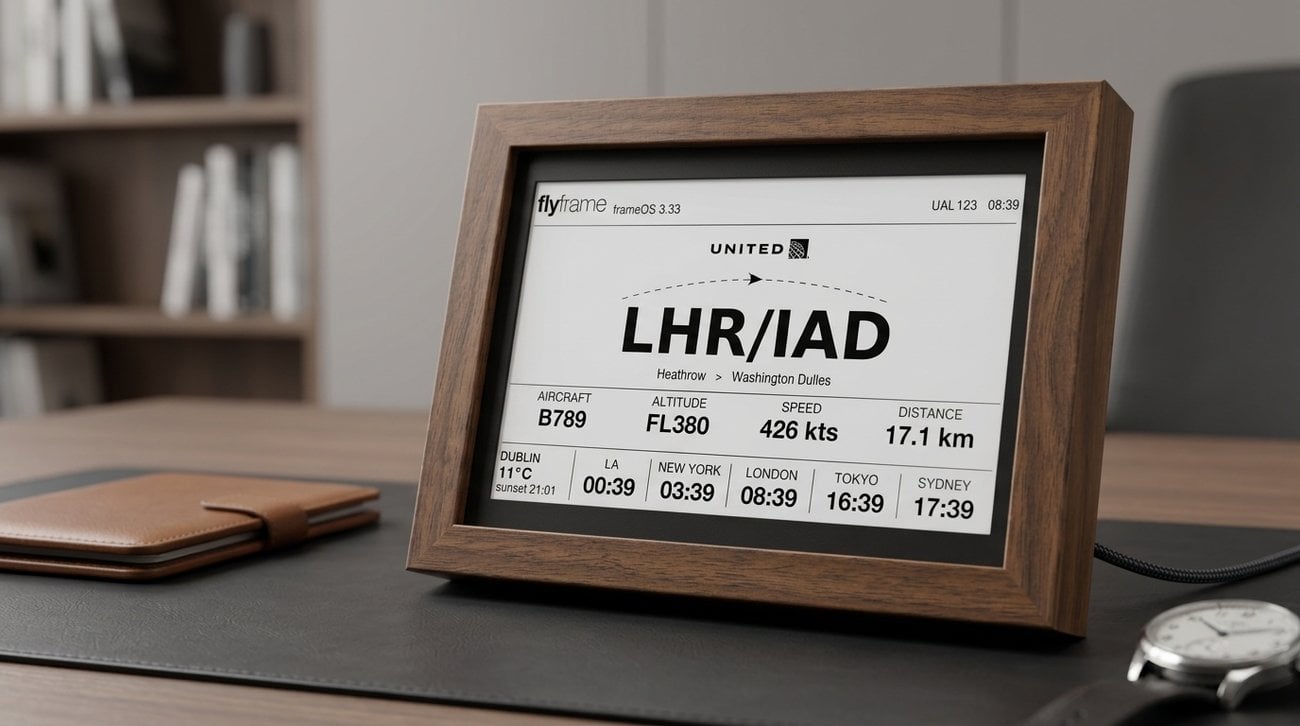
Here's the thing about flying a hundred-plus times a year: the sky stops being background. You start noticing routes, wondering where everyone's going, looking up when you're on the ground too. That's literally why I built FlyFrame - a live e-ink flight tracker that shows the aircraft passing over your home in real time. All the kit above makes the flying better; FlyFrame is the one that brings the sky home with you. Sky in a box.
That's my list - refined over more airports than I'd like to admit. If you're shopping for a frequent flyer rather than being one, our gift guides have you covered too.
Frequently asked questions
- What are the essential gadgets for frequent flyers?
- The ones that earn their place in a carry-on every single trip: a power bank, good noise-cancelling headphones, a Bluetooth adapter to use them with in-flight entertainment on long-haul, a phone stand for short-haul with no screen, a Kindle or iPad, and the small sleep kit - eye mask and a packable pillow. Lounge access and a suitcase that wheels itself do the rest.
- What should you pack in your carry-on for a flight?
- Anything you can't afford to lose or be without: a charged power bank (in your carry-on, never checked - airline rules), headphones, medication, documents, and a change of essentials. Then the comfort layer - moisturiser, eye mask, pillow - and something to read or watch offline.
- Do noise-cancelling headphones actually work on a plane?
- Yes - engine drone is a constant, low-frequency sound, which is exactly what active noise cancellation handles best. A good pair genuinely makes a flight quieter and shorter-feeling. On long-haul, pair them with the seat's screen using a Bluetooth adapter rather than the free plastic headset.
- How do you sleep on a plane?
- Block the light (a contoured eye mask), support your head (a packable or inflatable pillow so it doesn't loll forward), cut the noise (headphones or earplugs), and pick a window seat so no one climbs over you. The rest is practice - and lowering your standards a notch.
Keep reading
How to Actually Sleep on a Plane
A frequent flyer's practical guide to sleeping on a plane - the right seat, the small kit that works (eye mask, pillow, earplugs), the taping-and-hydration tricks, and how to land less wrecked.
The Best Gifts for a Frequent Flyer
Shopping for someone who's always on a plane? The best gifts for a frequent flyer - the kit that makes a life in the air smoother, and the one that brings the sky home between trips.
The Best Duffle Bags: Durable, Stylish Weekenders (2026)
The best duffle and weekender bags for travel: durable, stylish, mostly leather - the LV Keepall, Rimowa Never Still, Filson, Ghurka, Bennett Winch and made-in-USA picks.
How to Care for Your Aluminium Rimowa (and Whether to Cover It)
A hands-on guide to caring for an aluminium Rimowa: how to remove scuffs and transfer marks, the truth about dents and patina, the plastic-cover debate, and looking after the wheels and leather handles.