Careers · Learning to fly · Kids & STEM
How to Become a Pilot: A Step-by-Step Guide from School to Cockpit
By Jake · 28 October 2026 · 10 min read
“I want to be a pilot” is one of the most common things children say, and one of the few childhood dreams with a clear, well-trodden path. It is demanding and it isn't cheap, but it is open to far more people than most families assume. This guide walks through the route age by age, written for Ireland, the UK and the rest of Europe.
A note before we start: rules change and every flight school and airline sets its own requirements. Treat this as a map, then check the details with your national aviation authority (the IAA in Ireland, the CAA in the UK) and the schools you are considering.
The short version
- Fall in love with flying (the easy bit).
- Study maths, physics and English at school.
- Get a Class 1 medical before committing money.
- Choose a training route: integrated, modular or an airline cadet scheme.
- Earn a commercial licence with instrument and multi-engine ratings, plus the airline theory (the “frozen ATPL”).
- Pass airline selection, complete a type rating, and join as a first officer.
- Build hours and experience, then upgrade to captain.
Ages 4 to 11: curiosity first
Nobody needs a career plan at seven. What matters is keeping the interest alive: looking up, asking where planes are going, visiting an airport viewing area, building models, reading about how flight works. Our guide on how to get your child interested in planes has plenty of ideas. Children who grow up curious about maps, weather and how machines work are already building the foundations pilots use every day.
Ages 12 to 15: get closer to real flying
- Flight simulators. A home sim with a basic joystick teaches how an aircraft responds to controls, how instruments work and how radio calls sound. Many pilots credit it with their early start.
- Youth aviation groups. In the UK the Air Cadets are a classic route into flying. Elsewhere, look for aero clubs, model aircraft clubs and aviation summer camps.
- Gliding. Gliding clubs welcome teenagers and it is real flying, with a real instructor. In many European countries teenagers can fly a glider solo from around 14.
- Work experience. In Ireland, Transition Year is a great chance to spend a week at an airport, airline, flight school or maintenance company. Ask early, places go fast.
Ages 15 to 18: the subjects and the first licence
School subjects. Maths and physics are the most useful: navigation, performance and weight and balance are all applied maths, and principles of flight is physics. Strong English matters because aviation runs in English worldwide. Airlines and schools usually ask for solid passes in maths and English; check their exact requirements well before exam choices are locked in.
The first lessons. You can start flying lessons before you can hold a licence. Under European rules you can fly an aeroplane solo at 16 and hold a private pilot licence (PPL) at 17. A PPL is not required for an airline career if you go the integrated route, but it is a brilliant way to find out whether you really love it before the big commitment.
The medical: do it early
To fly commercially you need a Class 1 medical certificate, issued after an examination by an approved aviation medical examiner. Most healthy young people pass, and things like wearing glasses are usually fine within limits. But some conditions can rule it out, so get the Class 1 medical before paying for training. It is the cheapest insurance in the whole process.
Choosing a training route
Integrated
A full-time course at one approved training organisation that takes you from zero experience to a commercial licence with instrument rating, multi-engine rating and the airline theory exams, typically in around 18 to 24 months. It is intensive, structured and well known to airlines. It is also the most expensive route up front, commonly costing six figures in euro all in.
Modular
The same licences, earned step by step: PPL, then hour building, then the theory exams, then the commercial licence and ratings, often at different schools. You can work alongside it and pay as you go. It takes more self-discipline and usually longer, but it can cost noticeably less and plenty of airline pilots trained this way.
Airline cadet schemes
Several airlines run cadet or “future pilot” programmes with partner schools. Depending on the scheme they may offer funding support, a guaranteed interview or a conditional job offer. Selection is tough (aptitude tests, interviews, group exercises) and places are limited, so treat them as a great option to apply for, not a plan to rely on.
After training: getting the first job
Newly qualified pilots usually hold a commercial pilot licence with the airline theory passed, often called a frozen ATPL. It “unfreezes” into a full airline transport pilot licence once you have the required flying experience (and are at least 21). Airlines then put new joiners through a type rating for the specific aircraft, such as the Airbus A320 family or the Boeing 737, and line training with a training captain.
From first officer, the path to captain depends on the airline, experience and how fast it is growing. Some pilots stay on short-haul for the home life, others aim for long-haul wide-bodies. Both are good careers.
What makes a good pilot (beyond the licence)
- Calm under pressure and good at following procedures.
- Clear communication and teamwork: modern airline flying is a two-person job.
- Spatial awareness and comfort with numbers.
- Curiosity about weather, geography and how systems work.
- Resilience: training includes exams and check rides that not everyone passes first time.
How parents can help (without pushing)
Keep it fun, keep it real. Talk about the planes over your house and where they are going. Let them try a simulator or a glider flight. Encourage the maths. Help them talk to real pilots: flying clubs and airline open days are full of people happy to share how they got there. And if they decide they would rather be the engineer, the air traffic controller or the meteorologist, that is a win too; see our guide to aviation careers beyond the cockpit.
Already on the path? Our gifts for a student pilot guide has ideas for the celebrations along the way, from first solo to licence day.
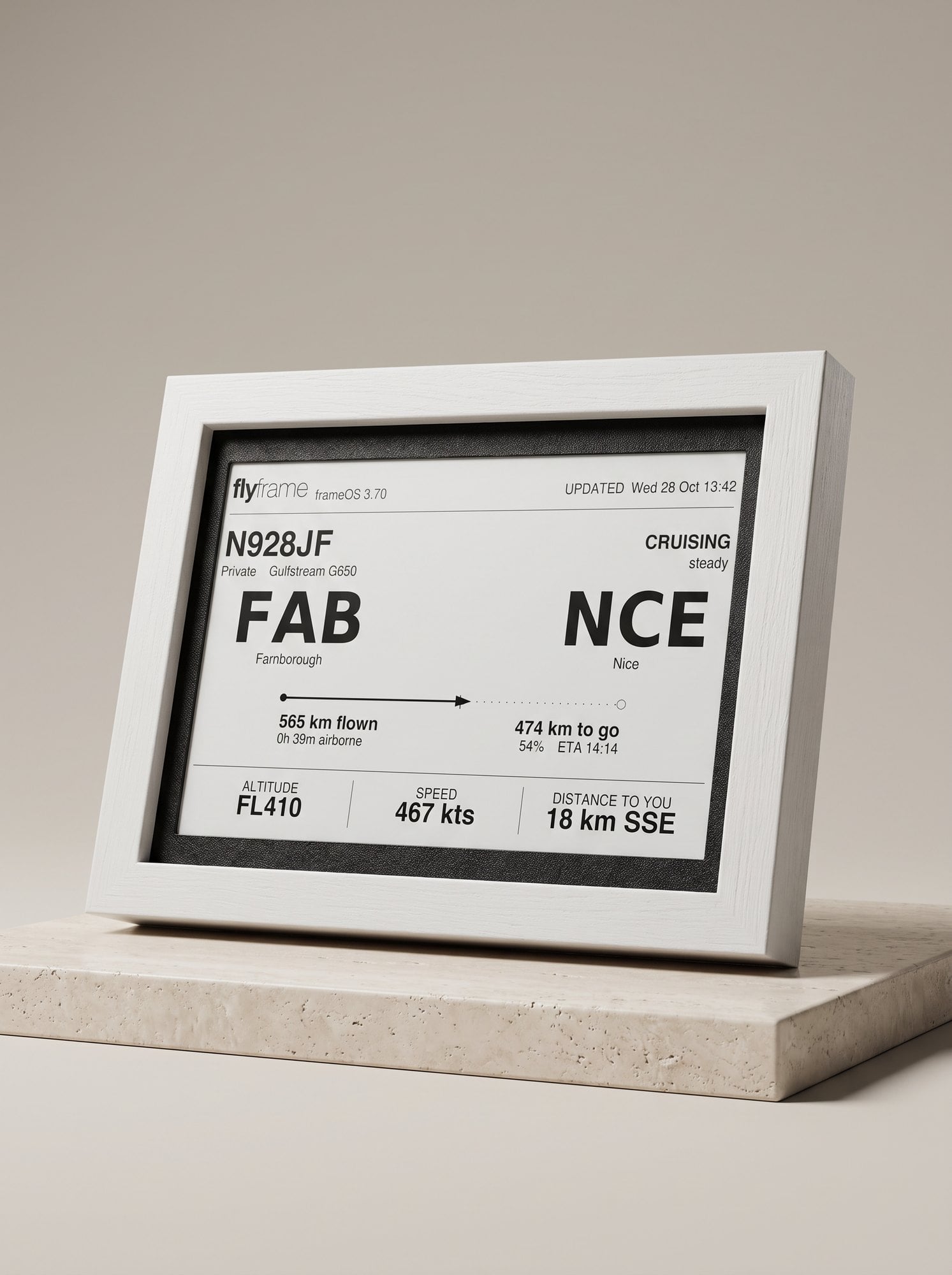
Many pilots say it started with a window, a garden or a back seat and a plane overhead. A FlyFrame on the bedroom wall shows the real flights passing over your home, where they're from and where they're going, which is not a bad way to start.
Frequently asked questions
- Do you need a degree to become an airline pilot?
- No. Airlines in Ireland, the UK and Europe recruit pilots without degrees. What you need is a commercial pilot licence with the right ratings (usually an ATPL, often called a 'frozen' ATPL until you have the flying hours), a Class 1 medical certificate, and to pass the airline's own selection. Good maths, physics and English help a lot.
- What age can you start flying?
- You can take flying lessons before you can hold a licence. Under European rules you must be 16 to fly an aeroplane solo and 17 to get a private pilot licence. Gliding often starts younger, with solo flights possible from around 14. A commercial licence needs you to be 18, and a full airline transport licence 21.
- What subjects should my child study to become a pilot?
- Maths and physics are the most useful, and strong English matters because it is the language of aviation. Airlines and flight schools set their own entry requirements, so check them, but solid passes in maths and English are the usual baseline. Geography and any science help with navigation and meteorology.
- How much does pilot training cost?
- It varies a lot by route and country. A full-time integrated course to airline standard commonly costs six figures in euro once everything is included. The modular route spreads the cost over time. Some airline cadet schemes help with funding or guarantee a job interview, but places are very competitive.
- When should you get the pilot medical?
- Before you spend serious money on training. A Class 1 medical, done by an approved aviation medical examiner, confirms you can hold a commercial licence. A few conditions can rule it out, and it is far better to know that at the start.
Keep reading
Is It Too Late to Learn to Fly? Learning to Fly as an Adult
Never too late: how adults learn to fly for fun or switch career, from a trial lesson to a private licence, the medical, the time it takes and how to start.
Aviation Careers Beyond the Cockpit: 12 Jobs for People Who Love Planes
Love planes but not sure about being a pilot? Air traffic control, aircraft engineering, aerospace design, dispatch, meteorology, cabin crew and more, with how to get in.
How to Get Your Child Interested in Planes and Flying
Simple, screen-light ways to turn the planes over your house into a love of flying, geography and science, for toddlers to teens (and curious grown-ups).
10 Plane Spotting Games for Kids (No Airport Needed)
Easy plane games for the garden, the window or the school run: guess the destination, plane bingo, sky passports and more. Free, screen-light and sneakily educational.