Kids & STEM · Family · Plane spotting
How to Get Your Child Interested in Planes and Flying
By Jake · 28 October 2026 · 7 min read
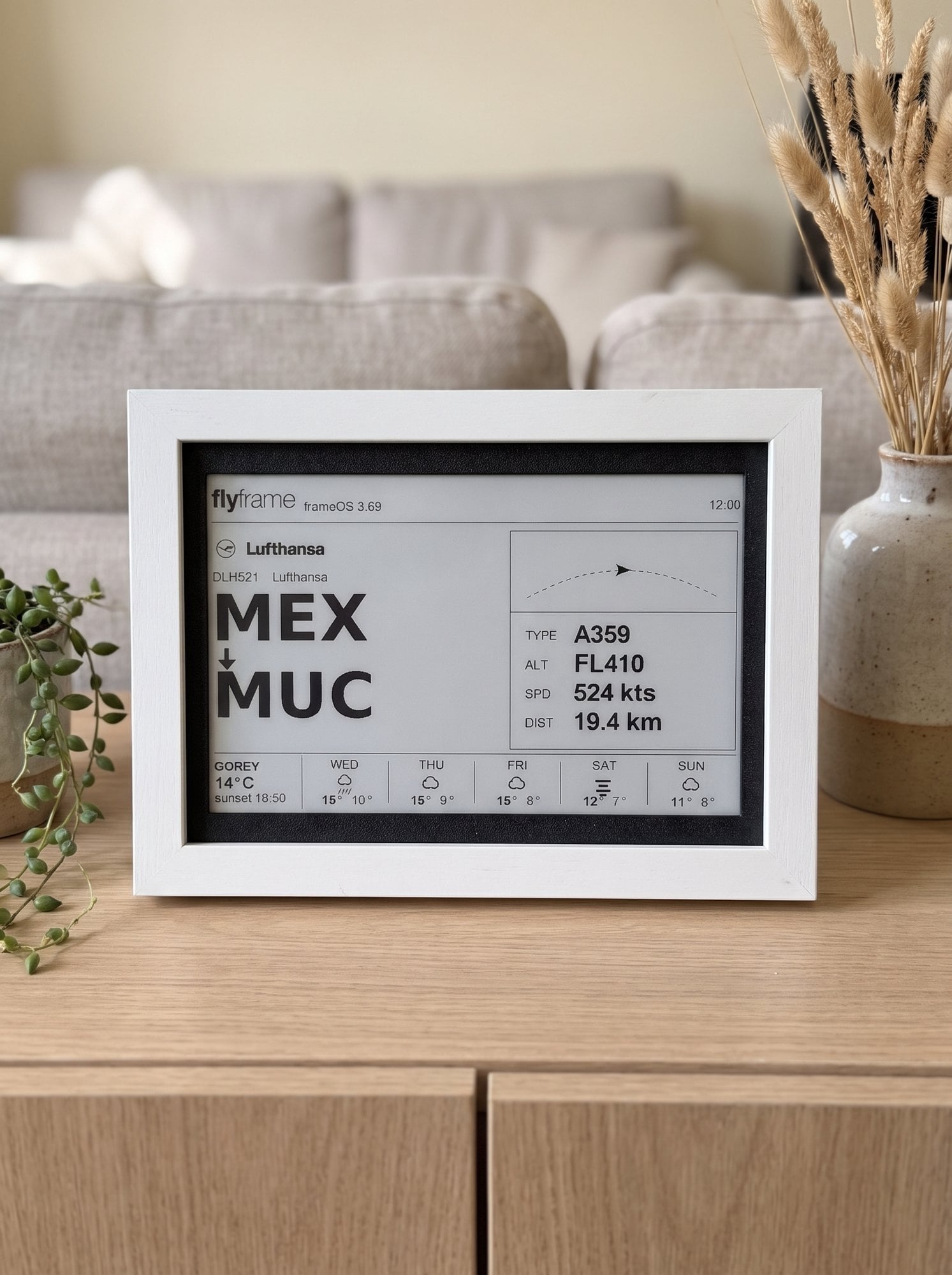
Almost every child goes through a phase of pointing at the sky and shouting “plane!”. For some it passes. For others it turns into a lifelong love of flying, travel, maps and how things work. You can't force that second path, but you can make it much more likely, and it costs very little. Here is what works, roughly in order of age.
1. Start with the planes you already have
You don't need an airport. Unless you live somewhere very remote, planes pass over your home every day, often dozens of them. The single best habit is simply to look up together and ask one question: where do you think that one is going?
Then find out. A flight-tracking app works, or a display that does it for you (more on that below). The moment a child learns that the tiny silver dot is a real aeroplane full of people flying to Lisbon, Boston or Dubai, the sky stops being background and becomes a story. Our guide on how to tell what plane is flying over your house covers the options.
2. Make the numbers make sense
“Eleven thousand metres” means nothing to a six year old. “higher than 30 Eiffel Towers stacked on top of each other” does. Kids connect with comparisons they can picture:
- Height: towers, mountains, or “higher than the clouds”.
- Speed: faster than a cheetah, faster than a car on the motorway, many times over.
- Size: a typical short-haul jet carries about as many people as six school classes.
- Distance: how many football pitches away it is right now.
This is exactly why we built Kids mode into FlyFrame. When a real plane passes, the frame shows big, friendly cards: how high it is in Eiffel Towers, how fast in cheetahs, how far away in football pitches, and how many classrooms of people it carries.
3. Turn every flight into a place on the map
A flight is a line between two places, which makes it the easiest geography lesson there is. Keep a world map or a globe near the window. When a plane goes over, find where it came from and where it is going. Ask what the weather might be like there, what language people speak, what time it is.
Over a few weeks your child builds a mental map of the world, anchored to real things they saw. Kids mode does a version of this with a sky passport: every new destination a plane over your house is heading to gets stamped, so “places so far” grows over time.
4. Collect, don't just watch
Children love collections. Spotting is a natural one: keep a notebook of aircraft types seen (Airbus A320, Boeing 737, the rarer jumbo or giant A380), or a sticker chart. Ticking off a new type is a small win, and learning to tell a 737 from an A320 builds real observation skills. FlyFrame's Kids mode keeps a plane sticker book for you, with question marks for the types still to find.
5. Read it as a story
For younger children, narrative beats facts. “This plane woke up in Dublin this morning and now it's flying over our house all the way to Faro” is far more memorable than a flight number. Make up the rest together: who is on board, what they'll do when they land.
6. Go and see them up close
Once the interest is there, a trip to an airport viewing area is a huge day out. Many airports have public viewing spots or a nearby field where spotters gather. Bring snacks, ear defenders for little ones, and a list of types to tick off. Our list of the best plane spotting airports in the world has some bucket-list ideas, and plane spotting for beginners covers the basics.
7. Let them build and fly
- Paper planes are a free physics lesson: change the wing shape, see what happens.
- Model kits for older kids who like making things.
- A simple flight simulator for teenagers. It is a genuinely good way to learn how aircraft are controlled, and many real pilots started there.
- A trial lesson or a glider flight for teens who are really hooked. Local flying and gliding clubs often run them.
Looking for presents? We put together gifts for a plane-mad kid that teach something.
It isn't only for kids
Here is the secret: grown-ups love this too. Plenty of adults never lost the urge to look up, and “as high as 19 Eiffel Towers” is just as satisfying at 45 as it is at 5. Grandparents especially enjoy it, because it gives them something to talk about with the grandchildren on every visit. Kids mode is a theme, not an age limit.
Keep it light
The goal isn't to raise a pilot (although if that is where it leads, read our step-by-step guide to becoming a pilot). The goal is curiosity: a child who looks up, wonders where things go and wants to find out. Planes just happen to be a brilliant, free, daily way to get there.
Frequently asked questions
- How do I get my child interested in aviation?
- Start with the planes that are already over your house. Look up together, find out where each one is going, and turn it into a small daily ritual. Add a trip to an airport viewing area, a model kit or a simple flight sim later. Curiosity grows from repetition and shared moments, not from one big present.
- What age can kids start plane spotting?
- Any age. Toddlers love pointing and waving, four to eight year olds love numbers and comparisons (how high, how fast, how far), and older kids can learn aircraft types, airport codes and how routes work. The hobby grows with them.
- How can planes teach kids geography and science?
- Every flight has a start and an end, so it is a ready-made geography lesson: find both places on a map, talk about the distance and the time difference. Height and speed bring in maths and science, and contrails, weather and why big jets fly so high are great questions to explore together.
- Is a flight tracker suitable for a child's room?
- An e-ink flight tracker like FlyFrame suits a child's room well: no glowing screen, no app, nothing to tap or scroll, and it quietly updates when a real plane passes. Its Kids mode shows big friendly cards made for young plane spotters.
Keep reading
10 Plane Spotting Games for Kids (No Airport Needed)
Easy plane games for the garden, the window or the school run: guess the destination, plane bingo, sky passports and more. Free, screen-light and sneakily educational.
Gifts for a Plane-Mad Kid That Teach Something (2026)
For the child who points at every plane: gifts that feed the obsession and teach geography and science, from model kits to a live flight tracker.
How to Become a Pilot: A Step-by-Step Guide from School to Cockpit
Want to fly for an airline? The real path, age by age: school subjects, the medical, training routes, costs and what teens can do now. Written for Ireland, the UK and Europe.
Aviation Careers Beyond the Cockpit: 12 Jobs for People Who Love Planes
Love planes but not sure about being a pilot? Air traffic control, aircraft engineering, aerospace design, dispatch, meteorology, cabin crew and more, with how to get in.