How it works · Flight tracking · Plane spotting
How to Tell What Plane Is Flying Over Your House
By Jake · 4 August 2026 · 6 min read
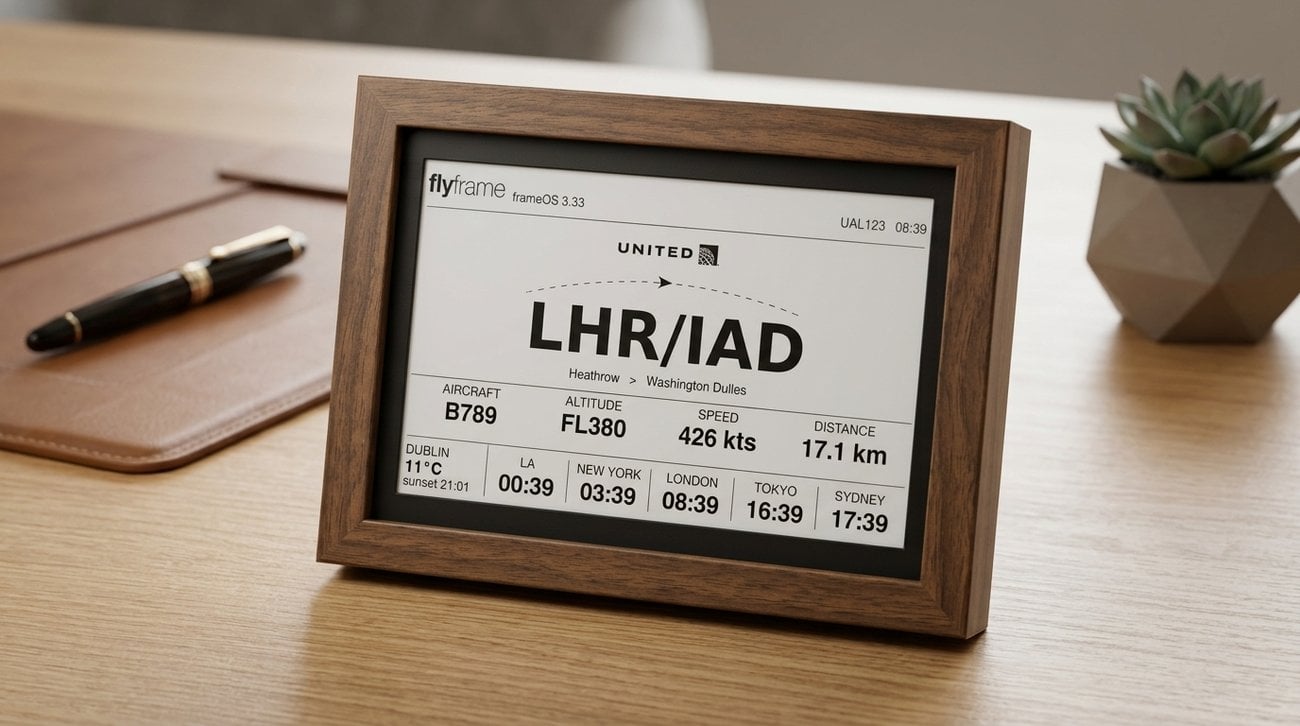
You hear it before you see it, look up, and there it is - a jet crossing your patch of sky. So what is it, and where's it going? The good news: every airliner tells you, if you know where to look. Here are the three ways to identify any plane flying over your house.
The short answer
Aircraft broadcast their identity and position continuously over ADS-B, an open signal anyone can receive. So identifying the plane overhead just means reading that broadcast - with a phone app, a dedicated display, or (for a rough guess) your own eyes.
1. A flight-tracking app
The quickest start: open a live flight-tracking app, allow your location, and tap the aircraft above you. You'll get the airline, flight number, type, origin, destination and altitude in seconds. Perfect for a one-off “what was that?” - the only catch is you have to have your phone out and hunt for the right dot.
2. An always-on display (no phone needed)
If you find yourself checking often, an ambient display is far nicer. A flight tracker on e-ink like FlyFrame sits on your wall or shelf and shows the aircraft passing over your exact location continuously - airline, flight number, type, route and altitude - so the answer is already there whenever you glance up. It's the difference between looking it up and simply knowing. This is why people who live under a flight path tend to end up with one.
3. By eye (a surprisingly good rough guide)
- Size & engines: two engines under a big wing = a typical airliner (737/A320 family); four engines or a very large body = a long-haul heavy (747, A380, 777).
- Altitude & angle: low, slow and gear-down means it's landing nearby; a thin contrail miles up means it's just passing over.
- Tail & livery: binoculars reveal the airline's colours and logo on the tail.
You'll get the category by eye - for the exact flight, you still want the broadcast data.
What the details actually mean
- Callsign / flight number - how the flight identifies itself; the airline code is your first clue to who's overhead.
- Aircraft type - the model, e.g. Boeing 737-800 or Airbus A320.
- Altitude - high and level = en route; low and descending = on approach.
- Origin → destination - the story of the flight in two airport codes.
However you do it, the sky stops being anonymous. If you want it answered for you all day without lifting a finger, that's exactly what a FlyFrame is for - or, if you're curious about the hobby itself, start with our beginner's guide to plane spotting.
Frequently asked questions
- How do I find out what plane is flying over my house right now?
- Open a flight-tracking app or a live flight-tracker display and centre it on your location - it reads the aircraft's own ADS-B broadcast and shows the airline, flight number, aircraft type, origin, destination and altitude of the plane overhead. A dedicated display like FlyFrame does this continuously on your wall, so you don't have to reach for your phone.
- How is it possible to identify any aircraft overhead?
- Almost every airliner constantly broadcasts its identity and position over an open system called ADS-B. It's unencrypted, so any app, receiver or display that reads ADS-B can tell you exactly what's above you in real time.
- Can I tell what a plane is just by looking at it?
- Often roughly, yes - size, number of engines, tail shape and contrails narrow it down, and altitude tells you if it's on approach or passing through. But for the exact airline, flight and type, you need the aircraft's broadcast data, which an app or display decodes for you.
Keep reading
Plane Spotting for Beginners: How to Start Watching the Skies
New to plane spotting? A friendly beginner's guide - how flights are tracked, what the callsigns and types mean, the gear you actually need, and how to identify the aircraft passing over your own home.
Contrails, Explained: What Those White Lines in the Sky Really Are
What are contrails, why do some linger while others vanish, and are 'chemtrails' real? A clear, friendly explainer - plus why a contrail overhead is your cue to check which plane just passed and where it's headed.
What Is an E-Ink Flight Tracker? (And Why It Makes a Great Gift)
An e-ink flight tracker is a wall-mounted display that shows the aircraft passing over your location in real time. Here's how it works, what it shows, and why it's become such a popular aviation gift.
The Best Plane-Spotting Airports in the World
From Maho Beach to Myrtle Avenue, a spotter's tour of the best plane-spotting airports on earth - the famous approaches, the viewing terraces, and how to make the most of each.