How it works · Contrails · Plane spotting
Contrails, Explained: What Those White Lines in the Sky Really Are
By Jake · 4 August 2026 · 6 min read
You look up, and there it is: a crisp white line unspooling behind a plane, splitting a blue sky in two. Sometimes it fades in seconds; sometimes it lingers and spreads for hours. So what actually are those lines - and are the theories you've heard about them true? Here's the friendly, no-nonsense explainer.
What a contrail actually is
“Contrail” is short for condensation trail. Up at cruising altitude the air is brutally cold - often below −40°. A jet engine pumps out hot, humid exhaust, and when that water vapour hits the freezing air it does what your breath does on a winter morning, only far more so: it condenses and freezes into tiny ice crystals, almost instantly, tracing a white line across the sky. That's it. A contrail is a thin, man-made cloud made of frozen water.
Why some vanish and some linger
The difference isn't the plane - it's the air. It all depends on how much moisture is already up there:
- Dry air: the ice crystals turn straight back into vapour within seconds, and the trail disappears almost as fast as it forms.
- Humid air: the crystals hold on, and the contrail can persist and spread into wispy, cirrus-like sheets that drift for hours.
Same physics, different atmosphere. It's also a handy rule of thumb: lots of long-lasting, spreading contrails often means there's moisture moving in aloft - a rough sign of a change in the weather.
The “chemtrail” question - answered plainly
It's a fair thing to wonder: if two planes cross the same sky and one leaves a trail that lasts while the other doesn't, something must be different, right? Right - but that something is the humidity of the air each plane is flying through, not a hidden ingredient. There is no scientific evidence for the idea that persistent trails are chemicals being sprayed. Everything observed - why they form, why they linger, why they spread - is fully and simply explained by known atmospheric physics. The short version: it's frozen water, and the sky decides how long it stays.
Turn a contrail into a story
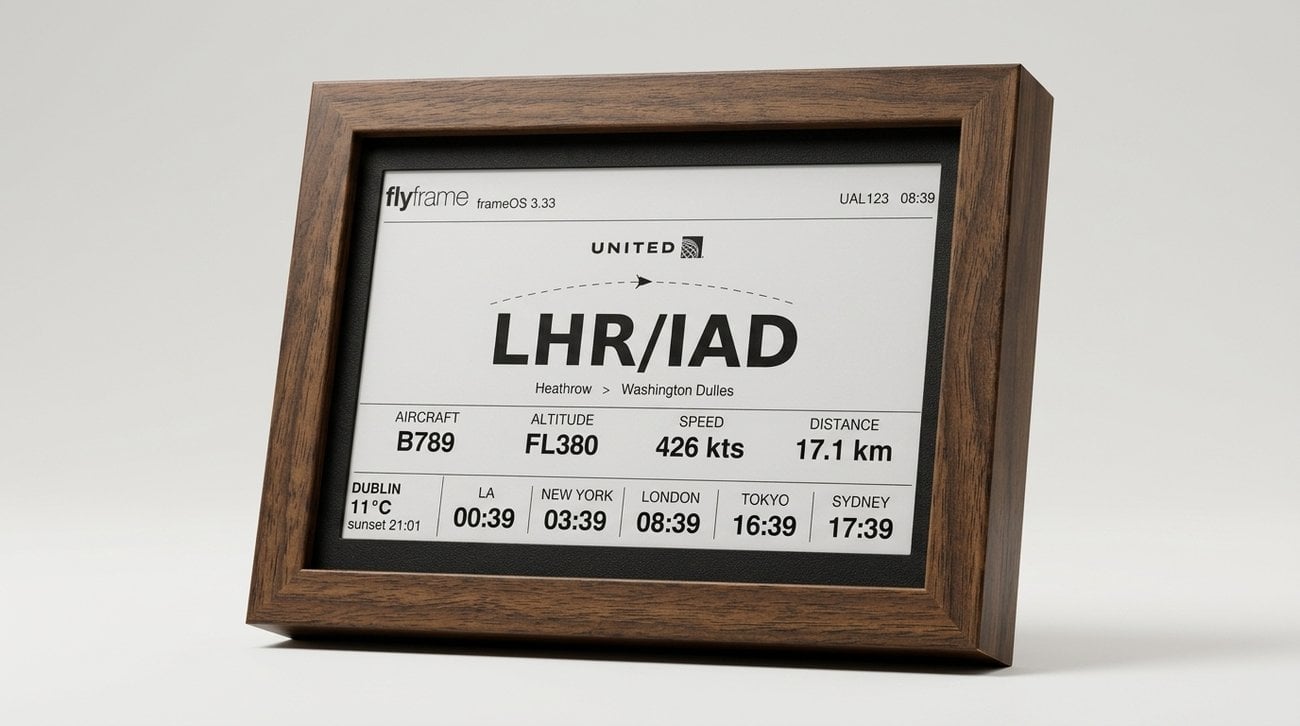
Here's the fun part. A fresh contrail is a cue. Someone is up there, right now, going somewhere - and you can find out exactly who and where. That's the moment to glance at your flight tracker: a FlyFrame on the wall shows the aircraft passing over your home in real time - the airline, the flight number, the type, and the route from origin to destination. So the next time a white line splits your sky, you don't just wonder what it was. You look up at the frame and know: that's a Dublin-New York flight at 38,000 feet, full of people on their way somewhere. The anonymous line becomes a little story you can read.
Want to get better at reading the sky in general? Start with how to tell what plane is flying over your house or our beginner's guide to plane spotting.
Frequently asked questions
- What are contrails?
- Contrails - short for 'condensation trails' - are thin clouds of ice crystals that form behind an aircraft at high altitude. Jet engines emit hot, humid exhaust; at the very cold temperatures found around cruising height, the water vapour freezes almost instantly into tiny ice crystals, drawing a white line across the sky. They're made of frozen water, nothing more.
- Why do some contrails disappear quickly and others spread out and linger?
- It comes down to how much moisture is already in the air up there. In dry air the ice crystals sublimate (turn straight back to vapour) within seconds and the contrail vanishes. In humid air they persist and can spread into wispy cirrus-like clouds that last for hours. Same physics, different atmosphere - which is also why contrails are a rough forecasting clue.
- Are 'chemtrails' real?
- No - there's no scientific evidence for the idea that persistent contrails are chemicals being sprayed. Everything we see is fully explained by known atmospheric physics: hot exhaust plus very cold, sometimes humid air makes ice clouds. The variation people notice (some trails linger, some don't) is exactly what humidity differences predict.
- How can I tell which plane left a contrail?
- Look it up while it's fresh. A flight-tracking app or an at-home flight tracker like FlyFrame shows the aircraft overhead in real time - airline, flight number, type, origin and destination - so the moment you spot a fresh trail, you can see exactly who drew it and where they're headed.
Keep reading
Plane Spotting for Beginners: How to Start Watching the Skies
New to plane spotting? A friendly beginner's guide - how flights are tracked, what the callsigns and types mean, the gear you actually need, and how to identify the aircraft passing over your own home.
How to Tell What Plane Is Flying Over Your House
Wondering what that aircraft overhead is? Here are the three ways to identify any plane flying over your house - a tracking app, an always-on display, or your own eyes - and what the details mean.
The Best Plane-Spotting Airports in the World
From Maho Beach to Myrtle Avenue, a spotter's tour of the best plane-spotting airports on earth - the famous approaches, the viewing terraces, and how to make the most of each.
How to Actually Sleep on a Plane
A frequent flyer's practical guide to sleeping on a plane - the right seat, the small kit that works (eye mask, pillow, earplugs), the taping-and-hydration tricks, and how to land less wrecked.